Thermocouple or RTD: which one fits your test bench?
The choice comes down to two numbers: the highest temperature you need to read and the uncertainty you can accept. Here is how to decide in a few minutes, and what to check before the first reading reaches your test software.
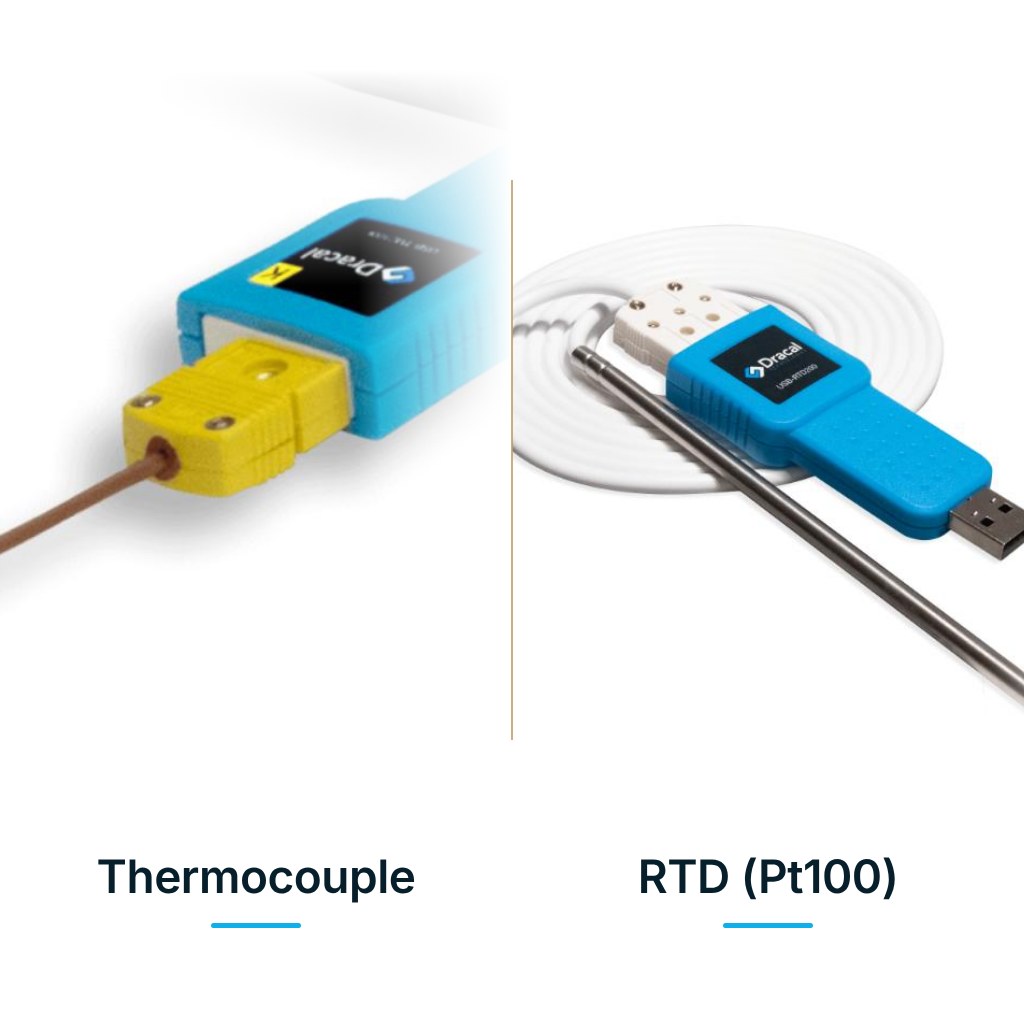
Thermocouple or RTD: which one should I use on my test bench?
If you need accuracy better than about ±1 °C between −200 °C and a few hundred degrees, use an RTD. If you need to go higher, measure a small part or follow fast changes, use a thermocouple. Most of the remaining decisions are about mounting and wiring.
| Your measurement | Better choice |
|---|---|
| Above roughly 500 °C (furnaces, exhausts, high-temperature burn-in) | Thermocouple |
| Small or moving parts, tight spaces, fast temperature changes | Thermocouple (bare welded junction) |
| Reference point, liquid bath or chamber where ±0.1 to ±0.5 °C matters | RTD (Pt100) |
| Long tests where the reading must not drift over months | RTD (Pt100) |
| Many points where ±2 to ±3 °C is acceptable | Thermocouple |
The sections below explain where these limits come from, so you can check them against your own setup.
What actually differs between a thermocouple and an RTD?
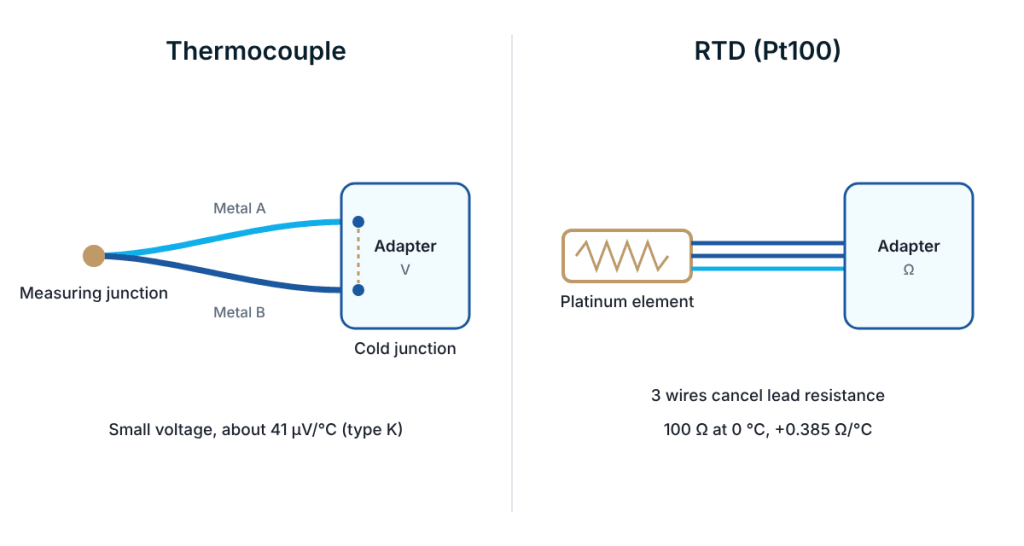
A thermocouple is two wires of different metals joined at the tip. When the tip and the other end of the wires are at different temperatures, the pair produces a small voltage, about 41 µV per degree for a type K. The instrument reads that voltage and adds the temperature of the connection point, called the cold junction, to get the tip temperature.
An RTD measures resistance instead. A Pt100 element is a platinum resistor of 100 Ω at 0 °C that gains about 0.385 Ω per degree. The instrument passes a small current through it and converts the resistance to temperature.
This difference explains most of what follows. A thermocouple reports a temperature difference, so its errors come from the cold junction and the wires. An RTD reports an absolute value from a stable metal, which is why it holds its accuracy over time. For more detail on the Pt100 itself, see what an RTD (Pt100) is.
How do they compare on range, accuracy, stability and response time?
The table compares the two technologies as you would buy them for a test bench. Probe tolerances come from the IEC standards; the last two rows give Dracal adapter and probe figures from their datasheets.
| Thermocouple | RTD (Pt100) | |
|---|---|---|
| Measurement range | Type K: −200 to 1372 °C at the adapter. The probe insulation usually sets the real limit. | −200 to 800 °C at the adapter. Most probes stop well below, often around 200 to 500 °C. |
| Probe tolerance (IEC) | Type K class 1: ±1.5 °C from −40 to 375 °C | Class A: ±(0.15 + 0.002 |t|) °C. 1/3 DIN: ±0.10 °C at 0 °C |
| Stability over time | Drifts with use, especially after long periods at high temperature | Very stable; platinum changes little with use |
| Response time | Fast with a bare welded junction | Slower; the element sits inside a sheath |
| Wiring | 2 wires. Extensions must use the same alloy | 2 or 3 copper wires. 3 wires cancel lead resistance |
| Mechanical strength | Tolerates vibration and high heat | Element is more fragile |
| Probe cost | Lower | Higher |
| Dracal adapter accuracy (probe excluded) | TMC200, type K: ±0.5 °C typical at 25 °C, ±1.5 °C maximum | RTD300: ±0.005 °C typical at 25 °C, ±0.008 °C maximum |
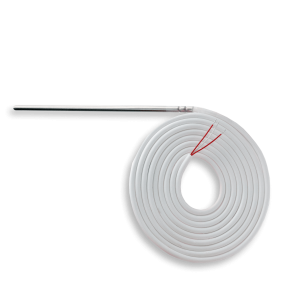
| Dracal pre-wired probe | Type K, FEP: ±2.2 °C typical | RTD-PT100-SIL, 1/3 DIN: ±0.14 °C from −25 to 25 °C |
Read the accuracy rows carefully. A datasheet often gives the adapter alone, and the probe adds its own error. With a good adapter, the probe is what sets the accuracy of an RTD measurement, while a thermocouple stays limited by its alloy tolerance.
What can go wrong in the measurement, and how do I avoid it?
Cold junction compensation (thermocouple)
Any error on the cold junction temperature goes straight into your reading. The adapter must measure it right at the probe terminals and stay at a stable temperature. The TMC200 compensates automatically and reports the cold junction temperature on its own channel, so you can verify it during a test.
Lead resistance (RTD)
With 2 wires, the resistance of the leads adds to the element. At 0.385 Ω per degree, 1 Ω of lead wire reads about 2.6 °C too high. A 3-wire probe, such as the RTD-PT100-SIL, lets the adapter cancel this error.
Self-heating (RTD)
The measuring current warms the element slightly. The effect is largest in still air with a small probe, and negligible in a stirred liquid. Keep it in mind when you compare an RTD in air with a reference in a bath.
A broken wire that still logs a value
On a long test, a disconnected probe should never pass for a plausible temperature. The TMC200 flags a disconnected probe or an out-of-range value in its status, so your script can stop or alert instead of logging bad data.
How do I get either one into my PC or my test software?
Dracal adapters connect either probe to a USB port. The TMC200 reads type K, J, N, E or T thermocouples. For Pt100 probes, the RTD200 gives ±0.06 °C at 25 °C, and the RTD300 gives ±0.005 °C at 25 °C with up to 10 samples per second when the reading serves as a reference. You can use your own compatible probe or order a pre-wired one.
DracalView is free and logs and graphs any number of Dracal instruments. To feed your test software, four tools are available. The free command-line tool and the free REST JSON API run locally on your PC, with no cloud service, and come with code examples in many languages. The free MQTT publisher pushes each reading to the broker of your choice, so several programs can subscribe to it. The paid VCP option lets your code read the adapter as a standard serial port. Which integration tool do you need? helps you pick one.
The -CAL option adds 3-point calibration that you run yourself in DracalView, ideally with your final probe connected, so the probe error is corrected along with the adapter. Five reasons to choose the -CAL option explains when it pays off. A traceable calibration certificate is also available as a separate purchase.

The probe sets the limit, the chain decides if you reach it
Choosing between a thermocouple and an RTD sets the best accuracy you can hope for. Whether you actually get it depends on the rest of the chain: cold junction, wiring, calibration with the final probe, and how the data reaches your test software. That is where most bench measurements lose their margin.
Compare the models in detail in the TMC series comparison and the RTD series comparison. If your setup has a constraint not covered here, describe it to us through the form below.
References and sources
- How accurate is a thermocouple? (IEC 60584-1 tolerance classes), TC Direct.
- What is the standard and tolerances for RTD Pt100 sensors? (IEC 60751), TC Direct.
- Comparison of the TMC series and comparison of the RTD series, Dracal Technologies.


Not sure if your project will benefit from Dracal’s solution?
Contact us, tell us about your project, and we’ll quickly determine if there’s a fit.
"*" indicates required fields
Always offered at no extra charge with our products!
EASY TO USE IN YOUR OWN SYSTEM
- Ready-to-use, accurate and robust real-time data flow
- Choose the interface that works best for you (CLI, virtual COM, REST API, MQTT Publisher)
- Code samples available in 10+ programming languages (Python, C/C++, C#, Java, Node, .NET, etc.)
- Operates under Windows, Mac OS X and Linux
- Usable with LabVIEW (CLI guide, Virtual COM guide)
- All tools packaged within one simple, free of charge, DracalView download
FREE DATA VISUALIZATION, LOGGING AND CALIBRATION SOFTWARE
- Get up-and-running in less than 3 minutes
- Operates under Windows, macOS X and Linux
- Real-time on-screen graphing and logging
- Log interval down to 0.5 second and configurable units (°C, °F, K…)
- Simultaneous use of unlimited Dracal sensors supported
- Simple user-calibration (products with the -CAL option)
- Connectivity with SensGate Wi-Fi/Ethernet gateway

PRODUCTS YOU CAN TRUST
Approved by engineers, scientists and researchers around the world.
Thousands of companies trust our products worldwide: