Do you really need a $2,000 environmental transmitter?
If you’ve ever spec’d environmental monitoring instruments for a lab, test bench, or quality station, you’ve probably landed on a Vaisala, a Rotronic, or a similar industrial transmitter. The quote came back somewhere between $1,500 and $3,500. You may have winced. You may have approved it anyway, because what else is there?
That question: “what else is there?”, is exactly the gap this article addresses. Between hobbyist breakout boards and industrial wall-mount transmitters, there is a category of USB measurement instruments that most engineers never find, because they don’t know the search terms that would lead them there.
This article compares industrial environmental transmitters (temperature + humidity + pressure) with the Dracal PTH450, a USB-connected alternative that delivers traceable, calibrated data to a PC for a fraction of the cost.

What $2,000+ buys you
Industrial transmitters from Vaisala (Indigo520 + HMP probe), Rotronic (HygroFlex5), or E+E Elektronik are designed for a specific architecture: a wall-mounted enclosure outputs a 4-20 mA or Modbus signal to a PLC, SCADA system, or data acquisition module. That architecture dictates the price.
Here is what you are paying for at the $2,000-$3,500 level:
A rugged metal enclosure rated IP66 or NEMA 4, built to survive plant floors, cleanrooms, and outdoor exposure. The Vaisala Indigo520 housing is die-cast aluminum, IK08 impact-rated, with chemically strengthened display glass.
Analog output conditioning. The transmitter converts sensor readings into industrial-standard 4-20 mA current loops or 0-10 V signals. This requires precision DACs, galvanic isolation, and loop-powered circuitry: components that add real cost.
A modular probe ecosystem. Vaisala’s Indigo platform accepts interchangeable probes (HMP1, HMP3, HMP7, DMP5, GMP252…) for humidity, dew point, CO₂, and more. You’re buying into a platform, not a single instrument.
ATEX/IECEx certification on some models (Rotronic HF5-EX), for use in explosive atmospheres.
Advanced diagnostics and local data logging. Touchscreen trend views, event logs, chemical purge cycles on the sensor, and local storage when automation systems are unavailable.
Every one of these capabilities is real, engineered, and worth paying for, but only if your application requires them.
The question most procurement teams don’t ask
The critical question is not “which industrial transmitter should we buy?” It is: “Does our application actually need an industrial transmitter?”
Consider the typical use case that leads an engineer to a Vaisala quote:
- You need temperature, humidity, and atmospheric pressure data on a PC.
- The environment is a lab, a test bench, a QC station, or a calibration room.
- You want traceable calibration (ISO 17025).
- You want to log data, possibly feed it into your own software (Python, LabVIEW, C#).
- The sensor sits indoors, at ambient temperature, in a controlled space.
None of these requirements call for 4-20 mA loops, NEMA 4 housings, ATEX certification, or Modbus RTU. You are paying $2,000+ for infrastructure you will never use.
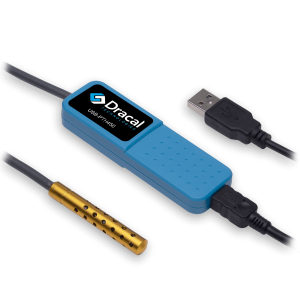
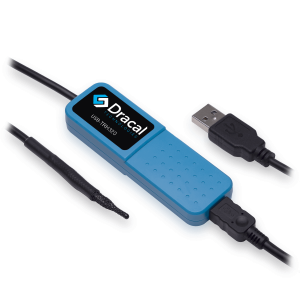
The Dracal PTH450 was designed for exactly this scenario. It is a USB-connected instrument that measures temperature (±0.1 °C), relative humidity (±1.5 %RH), and atmospheric pressure (±0.15 kPa at 25 °C) – and delivers all three readings, harmonized and timestamped, directly to your PC. No DAQ module. No signal conditioning. No wiring.
Feature-by-feature comparison
| Feature | Industrial transmitter (Vaisala Indigo520 + HMP1 + baro module) | Dracal PTH450 |
|---|---|---|
| Price (instrument only) | $2,600-$3,500+ (transmitter + probe, sold separately) | From ~$275 (USB-PTH450 base) to ~$375 (VCP-PTH450-CAL, fully loaded) |
| Parameters | T, RH, barometric pressure (with optional baro module) | T, RH, atmospheric pressure – all standard |
| Temperature accuracy | ±0.1 °C (HMP1 probe at 10-35 °C) | ±0.1 °C |
| RH accuracy | ±0.8 %RH (HMP1, 10-30 °C) | ±1.5 %RH |
| Pressure accuracy | ±0.15 hPa (Indigo520 baro module, at 20 °C) | ±0.15 kPa (at 25 °C), ±0.20 kPa (0-40 °C) |
| Data interface to PC | Modbus TCP/IP, RS-485, analog → requires DAQ hardware | USB – direct. CLI, REST API, or VCP serial |
| Software | Vaisala Insight (probe config + 48 h logging) | DracalView (free, unlimited logging, unlimited sensors) |
| Code integration | Modbus libraries required; no native code examples | Python, C, C++, Java, Node.js, C#, LabVIEW. Ready-to-use examples |
| Calibration | Factory only; probes shipped back to Vaisala or authorized lab | User-adjustable 3-point calibration (CAL option); ISO 17025 certificates from accredited labs of your choice |
| Enclosure rating | IP66 / NEMA 4 | IP51 (indoor use) |
| Setup time | Hours (wiring, configuration, commissioning) | < 3 minutes (plug USB, launch software) |
| Power | 15-35 VDC or 24 VAC (separate supply required) | USB bus-powered |
Two accuracy notes worth flagging. First, the Vaisala system achieves slightly tighter humidity performance (±0.8 vs. ±1.5 %RH). If your process requires sub-1 %RH accuracy, that matters. For most lab ambient monitoring applications, ±1.5 %RH is well within spec. Second, pressure accuracy is comparable: Vaisala’s ±0.15 hPa at 20 °C and Dracal’s ±0.15 kPa at 25 °C are functionally equivalent.
When an industrial transmitter IS the right choice
To be fair and transparent: there are applications where the Vaisala, Rotronic, or similar instrument is the correct tool. These include:
Process control loops. If the transmitter feeds a 4-20 mA signal into a PLC that controls an HVAC damper, a drying oven, or a cleanroom air handler, the industrial interface is mandatory. USB instruments do not belong in closed-loop control.
Hazardous environments. ATEX/IECEx-certified instruments (like the Rotronic HF5-EX) exist because explosive atmospheres are real. No USB instrument is certified for Zone 1.
Harsh physical conditions. Outdoor weather stations, food processing plants with high-pressure washdowns (IP66+ required), or environments with sustained chemical exposure demand the housing and probe materials of industrial-grade instruments.
SCADA integration on existing infrastructure. If your facility already runs on Modbus RTU/TCP and the environmental data must flow through the same pipeline, adding a Modbus-native transmitter is the path of least resistance.
Ultra-tight humidity tolerances. Semiconductor fabrication, pharmaceutical stability chambers, and certain metrology labs require ±0.5 %RH or better. The Vaisala HUMICAP platform delivers this; the PTH450 does not.
If your application checks one or more of these boxes, the premium is justified.
When USB is the better approach
For every other scenario, and in our experience this covers the majority of lab and QC use cases, a USB instrument is simpler, cheaper, and faster to deploy.
Lab ambient monitoring. ISO 17025 and ISO 8655 require environmental conditions to be recorded during calibration. The Dracal PTH450 gives you T, RH, and pressure in one instrument, with traceable certificates, for under $500. Mettler-Toledo Rainin’s calibration labs use this exact instrument for their ISO 8655:2022 compliance.
Test bench data acquisition. If the data ultimately goes to a PC running Python, LabVIEW, or a custom application, routing it through 4-20 mA and a DAQ module adds cost, latency, and failure points. USB eliminates the entire signal chain.
Multi-point monitoring. Need five sensors on one PC? Five PTH450s plug into a USB hub and appear simultaneously in DracalView or your script. Five Vaisala transmitters require five power supplies, five signal cables, and a multi-channel DAQ module, at a combined cost that can exceed $15,000.
Portable or temporary setups. A USB instrument fits in a pocket. An industrial transmitter requires mounting hardware, a power supply, and wiring.
Integration: five lines of Python
One of the clearest practical differences is how quickly data reaches your code. Here is a working Python example using the Dracal PTH450 with dracal-usb-get:
import subprocess

# Channel 0 = Pressure (kPa), Channel 1 = Temperature (°C), Channel 2 = RH (%)
result = subprocess.run(
    ["dracal-usb-get", "-i", "0,1,2"],
    capture_output=True, text=True
)
pressure_kpa, temp_c, rh_pct = result.stdout.strip().split(", ")
Three calibrated, harmonized readings. No drivers, no DAQ configuration, no Modbus register maps. If multiple sensors are connected, add -s E24638 (your serial number) to target a specific unit. The equivalent workflow with a Vaisala Indigo520 requires either a Modbus TCP library and register address lookup, or purchasing a separate USB adapter for the probe, which bypasses the transmitter entirely.
The free DracalView software also provides real-time graphing, CSV logging, and Wi-Fi access (via the SensGate gateway) with zero coding.
The real cost equation
The instrument price is only part of the total cost of ownership. Dracal’s cost-benefit analysis breaks down the full picture for a five-station deployment:
| Cost element | Industrial transmitter (×5) | Dracal VCP-PTH450-CAL (×5) |
|---|---|---|
| Hardware | $10,000-$17,500 | ~$2,500 |
| DAQ / signal conditioning | $1,000-$5,000 | $0 (USB direct) |
| Integration engineering | 8-40 hours | < 2 hours |
| Annual calibration (freedom to choose lab) | Manufacturer-dependent | Open, any ISO 17025 lab |
| Software licensing | Varies (some SCADA licenses apply) | Free (DracalView, CLI, API) |
Over five years, the gap compounds. The Dracal solution’s annualized cost (including instruments, integration, and calibration) typically runs 4× to 8× lower than the industrial alternative for comparable measurement quality.
The article you might have missed
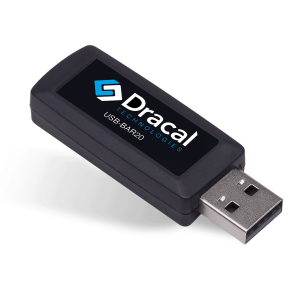
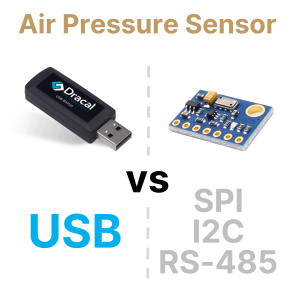
If you arrived here because you searched for a “precision barometer” or “atmospheric pressure sensor” and were quoted $2,000, you may also want to read. If your priority is atmospheric pressure only (no T or RH), the Dracal BAR20 is a single-parameter USB barometer starting at ~$165.
Conclusion
The Dracal PTH450 is a plug-and-play USB alternative to industrial environmental transmitters from Vaisala, Rotronic, or E+E Elektronik. It is designed for engineers who need temperature, humidity, and pressure data on a PC without 4-20 mA infrastructure. It is not a replacement for process-control transmitters, and it is not meant for ATEX zones or SCADA loops. But for lab monitoring, test benches, calibration rooms, and QC stations, it delivers equivalent accuracy at 5× to 15× lower cost, with setup measured in minutes rather than hours.
The question is not whether $2,000 transmitters are good instruments. They are. The question is whether your application actually requires one.
Some of our case studies
PRODUCTS YOU CAN TRUST
Approved by engineers, scientists and researchers around the world.
Thousands of companies trust our products worldwide:












Always offered at no extra charge with our products!
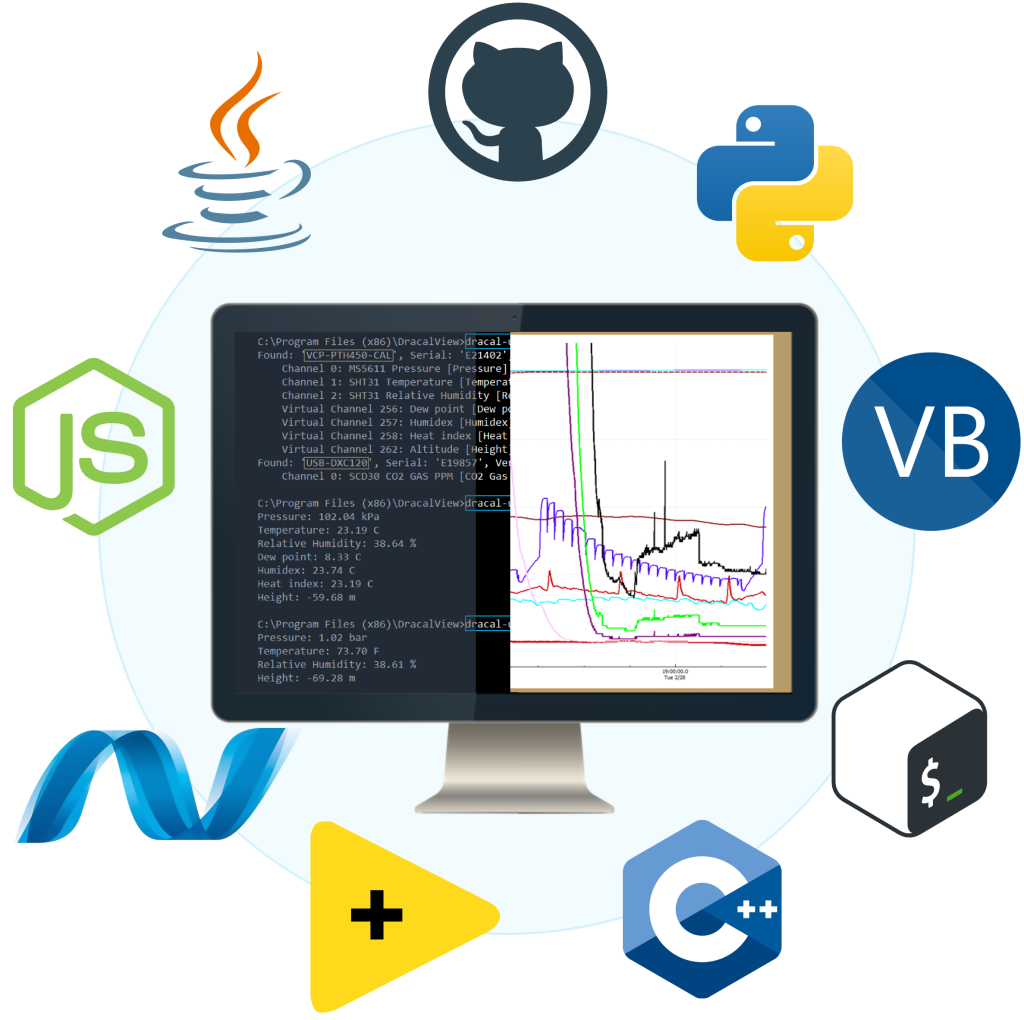
EASY TO USE IN YOUR OWN SYSTEM
- Ready-to-use, accurate and robust real-time data flow
- Choose the interface that works best for you (CLI, virtual COM, REST API)
- Code samples available in 10+ programming languages (Python, C/C++, C#, Java, Node, .Net, etc.)
- Operates under Windows, Mac OS X and Linux
- Usable with LabView (CLI guide, Virtual COM guide)
- All tools packaged within one simple, free of charge, DracalView download
FREE DATA VISUALIZATION, LOGGING AND CALIBRATION SOFTWARE
- Get up-and-running in less than 3 minutes
- Operates under Windows, Mac OS X and Linux
- Real-time on-screen graphing and logging
- Log interval down to 0.5 second and configurable units (°C, °F, K…)
- Simultaneous use of unlimited Dracal sensors supported
- Simple user-calibration (products with the -CAL option)
- Connectivity with SensGate Wi-Fi/Ethernet gateway
Not sure if your project will benefit from Dracal’s solution?
Contact us, tell us about your project, and we’ll quickly determine if there’s a fit.
"*" indicates required fields