Your experiment runs for weeks. Your environmental record needs to survive peer review.
For research scientists and lab managers who need calibrated environmental monitoring that integrates into their existing pipeline and holds up in publication.
When the logger fills its memory mid-experiment, the data gap cannot be recovered. When a reviewer asks how the instrument was calibrated, a model number is not enough.
Publication-quality documentation requires both traceable calibration and pipeline compatibility. Most options satisfy one. None satisfy both at a grant-budget price.
The traceability gap
Self-built solutions are callable from Python. But a breakout sensor has no traceable calibration path and no certificate that names an accreditation body.
The integration gap
Precision instruments from NI, Vaisala, and Fluke carry the documentation. A single monitoring point starts at $1,500. The data lives in vendor software.
A research scientist should not need a $3,000 enterprise platform to produce environmental data that holds up in a methods section.
We work with research scientists and lab managers at universities and national laboratories who need measurements defensible in publication and instruments priced for a grant budget.
No proprietary platform. No single-use vendor software. No recurring license fees.





2011
3-yr
50+
Three places in research laboratories where Dracal instruments are deployed
Each connects directly to your existing experimental data pipeline.
Temperature, humidity, or CO2 drift during an unattended run introduces confounding variables that cannot be corrected after the fact. Dracal logs continuously to your PC disk for the full duration of the experiment, with no memory limits, synchronized with your primary acquisition data by timestamp. When you submit, the environmental record is complete.
Grant reporting and ISO 17025 accreditation require that incubators, climate chambers, and calibration baths be verified against a traceable reference. Dracal with the -CAL option and an NRC/NIST-traceable certificate from Transcat serves as that reference. The certificate names the accreditation body and the instrument by serial number.
Remote observatories, tunnel instruments, and field stations have spare USB ports and no room for a DAQ chassis. Dracal integrates via a local REST JSON API on embedded Linux with no software dependency and no recurring license fees.
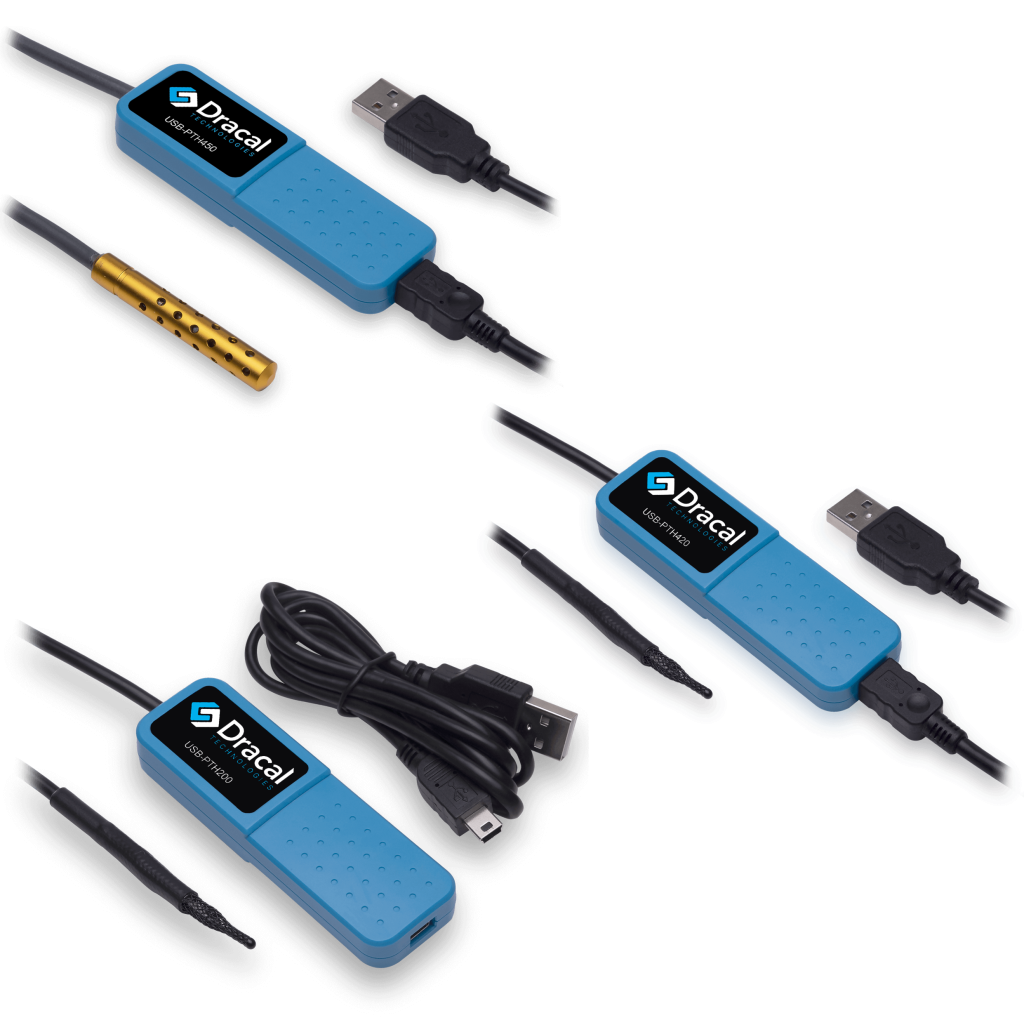
USB reference instruments for research laboratory environments
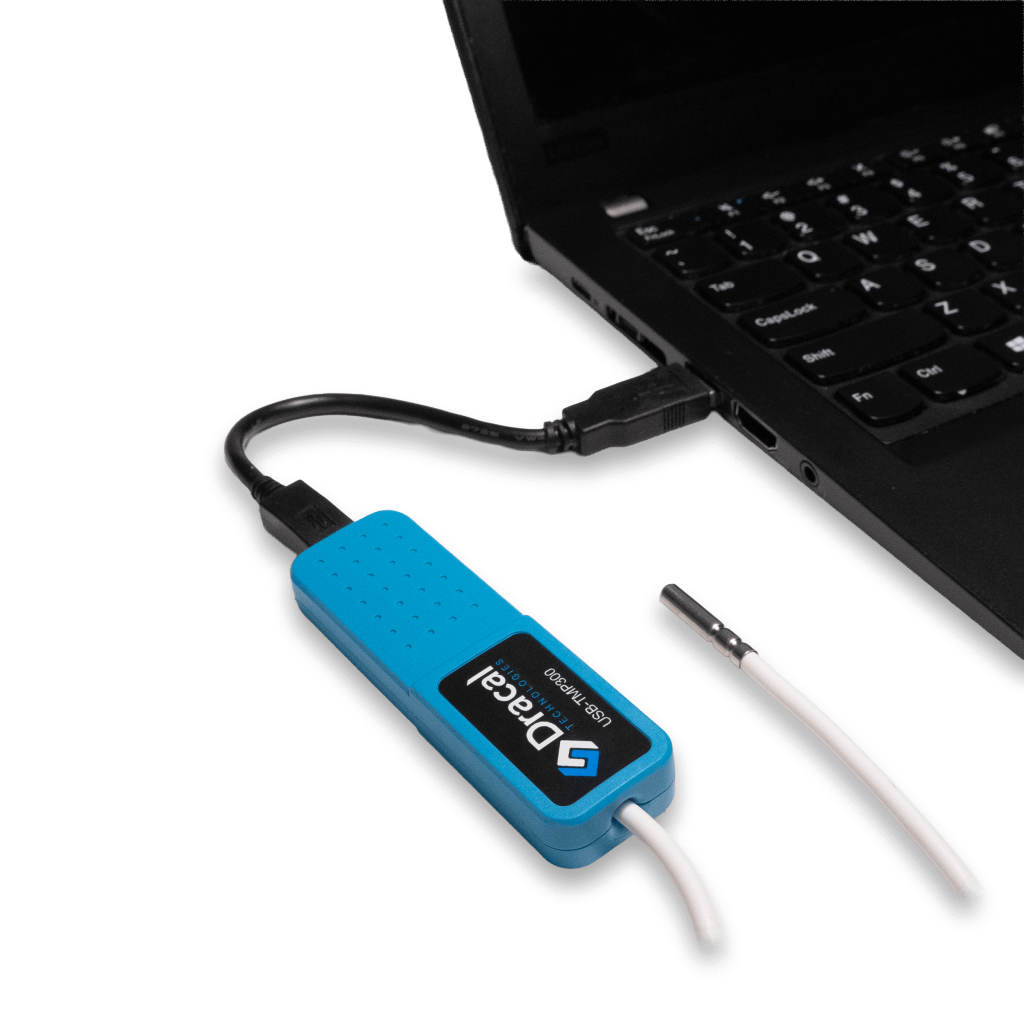
Unique serial number on every unit. Traceable calibration certificates available as a separate option.
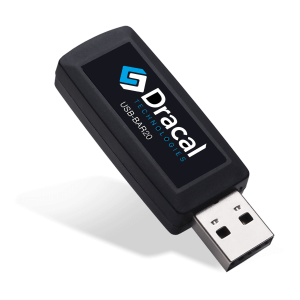
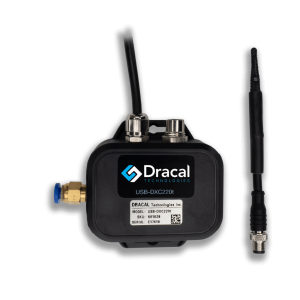
YOU RUN EXPERIMENTS IN A RESEARCH LAB
Engineering and prototyping
You need environmental measurements that read into your existing Python, LabVIEW, or MATLAB code. The data belongs in your pipeline, not in a vendor application.
YOU CALIBRATE OR VERIFY LABORATORY INSTRUMENTS
Calibration and Metrology
You verify incubators, calibration chambers, or temperature baths against a traceable reference. You need a certificate that names the accreditation body and links to the specific instrument.
YOU BUILD SCIENTIFIC INSTRUMENTS OR RESEARCH HARDWARE
OEM Integration
You embed environmental sensing into scientific instruments, field stations, or custom research hardware. You need a sensor that integrates into your firmware with no recurring license fees and no software overhead.
With Dracal reference instruments in your experiment setup, your calibration bench, and your deployed hardware, every environmental record is traceable. Your reproducibility documentation is covered.
That is what a research infrastructure you can stand behind looks like.
Measurement of ultra-sensitive sensor efficiency
Project: Optimization of the detection and resolution efficiency of ultra-sensitive sensors.
“A while ago you′ve asked me if the PTH200s I ordered were up to the task, and I would say yes! In fact, we are so satisfied with them that I′d like to order more.
We are using them to monitor environmental conditions during the laboratory and test beam measurements.
In the attached photo [omitted] you can see the PTH sensor in the measurement setup we use to measure silicon pixel sensor detection efficiency and spatial resolution using minimum ionising particle beams!“
Reliable monitoring of critical parameters in nuclear physics research
“In our nuclear physics research, we continuously monitor environmental conditions with high precision, recording data 24/7. We’ve integrated Dracal PTH450 the data into a LabVIEW VI, and Dracal’s sensors have been very easy to use and integrate. The command-line tool was particularly useful.
We chose Dracal primarily for its cost-effectiveness, ease of interfacing, and the ability to calibrate instruments, which is crucial for the reliability of our data.”

Reliable, real-time control of laboratory conditions in no time
“I wanted to have a better solution to monitoring laboratory conditions in a room where we carry out calibrations of oceanographic instrumentation – before I had a stand-alone sensor that you had to download, and the memory would fill up and so it wasn’t a reliable way of monitoring conditions at all.
With Dracal software, I can log and display this information on a computer that is running anyway, and the log files can be read by other software that controls our calibration tank.”