Replacing an obsolete OEM sensor in industrial fiber testing equipment

OEM sensor replacement and integration
Industrial textile testing equipment manufacturing
Who is this use case for?
Industrial equipment manufacturers who need to replace a discontinued OEM sensor while preserving an existing COM port integration, supporting legacy Windows deployments, and maintaining ISO-traceable environmental records in their product’s test reports.
What is this about?
OEM replacement of a discontinued temperature and humidity sensor across two industrial product lines, integrating via VCP mode into an existing proprietary software stack on Windows 7 and Windows 10 LTSC. T/RH readings are automatically included in every product test report.
Customer Story
Feedback from the senior software engineer and mechanical engineer responsible for the main product lines at a world-leading manufacturer of industrial fiber testing equipment.
″We manufacture two families of industrial fiber testing machines. Each machine includes an integrated temperature and humidity sensor, because environmental conditions have significant effects on cotton measurements: humidity affects fiber moisture content and physical properties, and temperature influences the readings in ways that matter for accurate, repeatable results. Every test report includes the T/RH conditions at the time of the run, so our customers can interpret their results correctly across sessions and locations.
When our existing T/RH sensor was discontinued by its supplier, we had no choice but to find a replacement. We use one or two sensors per machine depending on the configuration, so this was not a minor substitution. It affected our entire product line. We went with the virtual COM port model because we need it to run on legacy systems and also had concerns about maintenance and deployment of third party packages. And it had to work on Windows 7, because many of our customer installations worldwide still run on it. This is particularly true in cotton operations in developing countries where upgrading the operating system is not a priority.
Finding a USB temperature and humidity sensor that supports Windows 7 and Windows 10 LTSC and works within an existing proprietary software product without requiring proprietary drivers or third-party software is genuinely difficult. Most USB sensors on the market assume a modern, networked environment. They require complex installations or reconfiguration after every restart. Any of those would have required us to rework the integration or accept a dependency we could not carry into our product.
Our machines operate at customer sites worldwide: cotton mills, national fiber testing institutes, and trading operations. Our customer sites tend to be in not very developed parts of the world and while our operating instructions specify that the instrument should run in a climate controlled environment with a given temp/humidity range, that isn’t always the case and extreme shifts in local conditions affect not only the instrument itself but also the cotton sample being measured. The replacement sensor had to be robust enough to function reliably in those environments and require no ongoing maintenance from our team once deployed in the field. The pressure to find the right solution quickly was real, because the discontinued sensor was affecting our production schedule.
Dracal was the solution that checked every constraint. The VCP option communicates via standard COM port protocol, which matched our existing integration. Windows 7 support was confirmed, along with Windows 10 LTSC, which covers our full installed base. ISO 17025 calibration certificates are available with a unique serial number per unit, which some of our institutional customers require for their own quality documentation. The integration was straightforward.
We now deploy one or two Dracal sensors per machine across both product lines. Every test report our machines produce includes the T/RH conditions recorded at the time of the run. For our end-customers, this is not a convenience feature. Cotton fiber measurements are directly affected by the ambient environment, and having the environmental data in the report is part of producing results that can be compared across locations, seasons, and operators. More practically: the temperature and humidity readings at the time of running a test are included in the test report so if there are questions later about test data the customer (and us if it becomes a service question) can know, for that particular test, what the local conditions really were. The sensors have performed reliably at customer sites worldwide.″
The challenge
The discontinuation of an OEM temperature and humidity sensor used across two industrial fiber testing product lines forced a replacement with strict constraints: seamless COM port compatibility, support for Windows 7 and Windows 10 LTSC in globally deployed machines, and the ability to embed calibrated T/RH readings in machine-generated test reports for end-customers operating under quality management systems.
The solution
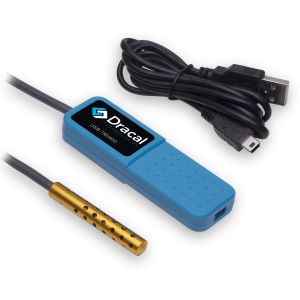
Dracal’s VCP-TRH450-CAL sensors, communicating via standard Virtual COM Port protocol, provided a drop-in replacement with almost zero changes to the existing integration code. Windows 7 and Windows 10 LTSC support and available ISO 17025 calibration certificates addressed every constraint. The sensor is now embedded in the two main product lines, with T/RH readings displayed on the product main screen and included in every product test report.
Sensors used for this project:
Prerequisites and limitations
To implement this solution, the following prerequisites and limitations are considered:
- An existing COM port (serial) communication integration in the product software. The sensor replaces a predecessor unit within the same communication architecture.
- A machine running Windows 7, Windows 10 LTSC, or later. The standard driver covers Windows 10 and above. The Windows 7 driver is available on request from Dracal support.
- Sensors must be ordered with the VCP option to enable Virtual COM Port communication. The base model (models with the USB- prefix) does not communicate via COM port by default.
- ISO 17025 calibration certificates are a separate purchase.
Implementation
- Order VCP-TRH450-CAL with the VCP option and ISO 17025 calibration certificate
- Connect the sensor to the existing COM port integration code.
- Adapt slightly the code using the documentation and codes examples in 10+ languages.
- Validate T/RH readings on the product against acceptance criteria.
- Reference the unique serial number in the machine’s calibration documentation and link to the ISO 17025 certificate for traceability
State after implementation
Dracal VCP-TRH450-CAL sensors are embedded per machine across the product lines, deployed at customer sites worldwide. Temperature and humidity conditions at the time of every test run are displayed on the main screen and included in machine-generated test reports, giving end-customers the environmental context they need to produce consistent, comparable measurements across locations and operators. The integration has required no maintenance since deployment, and Windows 7 compatibility has eliminated any upgrade requirement for existing installed-base machines in the field.
Not sure if your project will benefit from Dracal’s solution?
Contact us, tell us about your project, and we’ll quickly determine if there’s a fit.
"*" indicates required fields