Articles
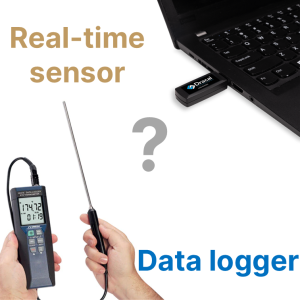
USB sensor or USB datalogger? They are not the same thing.
Articles
If you search for "USB temperature humidity sensor," most results are dataloggers. But a datalogger records data for later: it cannot stream live readings into your code. This article explains the difference and when each one is the right choice.
Read more

Do you really need a $2,000 environmental transmitter?
Articles
Between hobbyist breakout boards and $2,000+ industrial transmitters, there is a category of USB instruments most engineers never find. This article compares the Vaisala Indigo520, Rotronic HygroFlex5, and Dracal PTH450 for lab and QC applications.
Read more
How to read atmospheric pressure on a PC: the simplest setup for engineers
Articles
Not all paths to reading atmospheric pressure on a computer are equal. This article compares four approaches (weather station API, industrial 4–20 mA transmitter, microcontroller with breakout board, and USB barometer) on cost, accuracy, setup time, and integration effort, with working code examples for the simplest one.
Read more
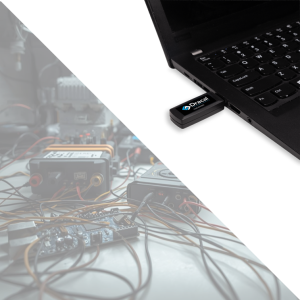
Why build a DIY USB barometer when you can buy one?
Articles
Before you wire a BMP390 or MS5611 to a microcontroller and design your own USB barometer, consider the full cost: firmware, enclosure, calibration, and long-term maintenance. This article breaks down the real engineering trade-offs between building your own atmospheric pressure sensor and buying one that's ready to plug in.
Read more
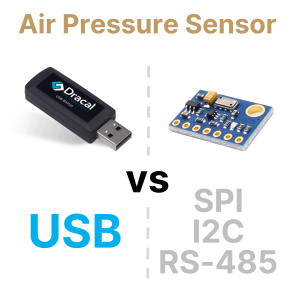
USB barometer vs. serial pressure sensors: why you might not need SPI, I2C or RS-485
Articles
Learn why inserting a microcontroller between an MS5611 breakout board and your PC adds unnecessary complexity when your goal is simply to read atmospheric pressure on a computer. This article compares the serial-protocol approach (SPI, I2C, RS-485) with the USB barometer approach, step by step, from hardware to software integration.
Read more
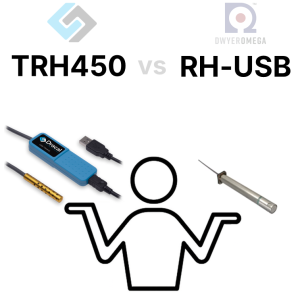
USB temperature & humidity sensor with datalogging software: Dracal TRH450 as an alternative to OMEGA RH-USB
Articles
Comparison of performance and available resources for Dracal's TRH450 USB temperature and relative humidity sensor and Omega's RH-USB.
Learn more

Which integration tool do I need?
Developer guides
Quickly understand the integration options offered by Dracal and determine which one best suits your needs.
Read more
The OEM sensor buyer’s guide: Making sense of your options
Articles about OEM integration
Choosing OEM sensors? Understand the trade-offs between DIY integration, smart modules, Fluke-style instruments, and USB precision sensors. Find your fit based on development time, support burden, and compliance needs.
Read more

6 signs you’re trapped by your sensor vendor
Articles
Discover 6 warning signs of sensor vendor lock-in—learn how to spot hidden costs, data traps, and limited integrations, and how to regain control.
Read more

How to win the race for precision data
Articles about OEM integration
Learn how to win the race for precision data integration. Discover the 3 keys to faster time-to-market, regulatory compliance, and cost control.
Read more

Dracal sensors as an alternative to National Instruments: When simplicity meets performance
Articles
Whether you are in the prototyping, testing, or production phase, discover how Dracal offers a robust alternative to National Instruments.
Read more

The smart integrator’s guide: Choosing the right sensor from design phase
Articles about OEM integration
Learn how to choose the right modular OEM sensor from design phase. Avoid hidden recalibration costs and gain client autonomy with our guide.
Read more

Calibration vs Recalibration: The difference every integrator must know
Articles about OEM integration
Discover why sensor calibration vs recalibration creates hidden costs for integrators. Learn the frequency, scope & strategic differences that impact customer satisfaction long-term.
Read more

Modular vs Non-Modular Solutions: How to transform recalibration into a competitive advantage
Articles about OEM integration
Discover how modular sensor solutions transform recalibration into competitive advantage. Reduce costs and eliminate downtime.

FAQ on calibration and recalibration of Dracal sensors
Articles about calibration
This FAQ answers the most frequently asked questions about the calibration and recalibration of your Dracal measuring instruments: recommended frequency, costs, choice of calibration points, etc.
Read more

How often should Dracal sensors be recalibrated?
Articles about calibration
We're sharing a step-by-step plan to help you answer one of the questions most frequently asked of our technical team at Dracal: how often should you recalibrate your sensors?
Read more

The 10-day plan for adding precision environmental data to your solution
Articles about OEM integration
A 10-day plan for integrating precision environmental data into your solution to increase your capabilities and customer satisfaction, while outpacing your competitors in innovation and time-to-market.
Read more
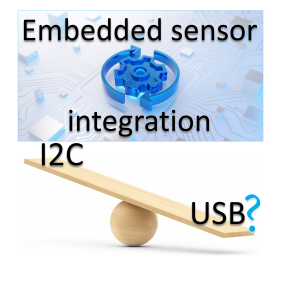
Best alternative to I2C sensors for embedded systems
Articles about OEM integration
In this article, we look at the best alternative to I2C for the embedded integration of precision sensors at the heart of industrial products. This article is aimed at small development teams working on large-scale products, where engineering time is highly valuable and essential to the go-to-market strategy.
Read more
What is the recalibration trap and how to solve it
Articles about OEM integration
The problem of recalibration concerns manufacturers who have integrated environmental sensors (temperature, relative humidity, atmospheric pressure, etc.) into products dedicated to standardized markets. Inevitably, these sensors have to undergo recalibration, and this is when too many engineering teams get caught out. In this article, we outline the origin of the problem, present the two criteria that an ideal solution to this problem must satisfy, and illustrate a concrete example of such a solution.
Read more
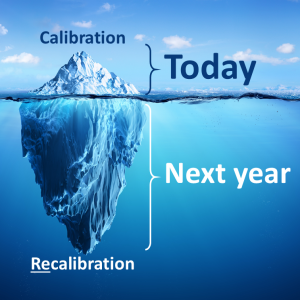
Beyond purchase price: Why recalibration capabilities should drive your OEM sensor selection
Articles about OEM integration
Learn why it's crucial, when designing products operating in highly controlled industries, to choose sensors that are easy to recalibrate by the end-user.
Read more