Adding traceable temperature logging to field-deployed utility meter test equipment

OEM integration in field-deployed test equipment
Electrical utility test equipment manufacturing
Who is this use case for?
Manufacturers of portable or field-deployed test and measurement equipment who need to add traceable temperature logging to an existing product, with ISO 17025 calibration certificates, unique serial numbers for audit trails, and a recalibration model that works for end-customers in the field without returning the unit to the manufacture.
What is this about?
Integration of a Dracal VCP sensor into an existing Windows 10 IoT embedded product to add temperature logging alongside meter accuracy test data, resolving a traceability gap created by a previous sensor with no serial number, and establishing a swap-based recalibration model for end-customers in the electric utility sector.
Customer Story
Feedback from the engineering and quality team of a manufacturer of portable test equipment for the electric utility sector. Cross-functional evaluation involving five stakeholders.
″We build field equipment that tests the accuracy of watt hour utility meters. There are a couple of pieces of equipment, each with USB ports and a built in computer running Windows 10 IoT. Some of our customers started asking us to record temperature during the testing, so we went looking for a USB temperature probe.
We found one from another company and we were not very happy with it. The sensor goes inside a box, next to a vent, to read temperature, and as the software team started to use the probe we ran into challenges. The one that really blocked us was that the probe was not serialized. When Windows did the USB handshake we could read a vendor ID and a product ID, but there was no serial number we could pull out of the registry, so we had no clean way to know exactly which device we were talking to before we opened a COM port.
The other problem was licensing. Our code is proprietary, and some of the integration software we looked at was GPL, which for us can be a non starter.
What was different about Dracal was that we could talk to the sensor over the serial COM protocol with no Dracal software and no license at all. We can delete every Dracal tool from the machine and still read the sensor, which removed the GPL problem for us completely. On top of that, every sensor carries a unique serial number, and we can reach any sensor and any channel by its serial number. Before we open a COM port we can verify on the USB vendor ID, which stays 289B, that it really is a Dracal device, so we get at least one step of validation and security before we start talking to a random device on the bus. The VCP mode also stays set after an unplug and a replug, so once a unit is converted it stays that way.
We tested and challenged the product over 6 months. Today, we integrate them into our field equipment and configure them automatically on the station we use to set up devices before we ship them, so each one leaves in VCP mode, identified first by its vendor ID and then by its own serial number per channel. We also want the option to support more products than just the one we started with. Ordering was simple, the web interface is very user friendly, and our end users, who are on Windows, can recalibrate on their own by swapping a sensor instead of waiting on us.″
The challenge
Adding temperature logging to a field-deployed utility meter test product on a Windows 10 IoT embedded platform, while meeting two non-negotiable requirements: unique serial number per instrument, ISO 17025 calibration certificates, and an integration path free of GPL-licensed code for a proprietary product software stack.
The solution
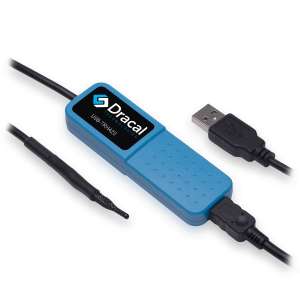
The Dracal VCP-TRH420 sensor is read over the serial protocol, which carries no license, so the proprietary integration code stays clean. Each unit confirms itself as a Dracal device through the fixed vendor ID before any port is opened, then exposes a unique serial number per channel once connected. Units are configured automatically on the customer production station.
Prerequisites and limitations
To implement this solution, the following prerequisites and limitations are considered:
- A Windows host on the equipment, since the field units and the end users both run Windows. The integration was built and tested on Windows 10 IoT.
- Proprietary integration code, which means the work is done over the serial protocol or the MIT licensed command line tools, and not the GPL licensed graphical module of DracalView.
- Units must arrive in VCP mode. Either order the VCP variant, agree an internal product code with Dracal so units ship pre configured, or run the one click Protocol Switcher or command line switch on the production station.
- Device identification before connection happens at the Dracal product level, not the unit level. The USB descriptor exposes the vendor ID
289Band a product ID (0500…0509in USB mode,0600…0609in VCP mode), while the unique serial number sits inside the device memory and is read only after the COM port is opened
Implementation
- Order VCP-PTH420 with the VCP option.
- Choose the integration path on the host: the serial COM protocol (VCP) for full license independence.
- Read each device USB vendor ID (
289B) and product ID to confirm a Dracal unit and to detect whether it is in USB or VCP mode, before opening any COM port. - Open the COM port and address each sensor by its unique serial number and channel number.
- Connect the sensor and integrate via COM port serial communication using the VCP code examples
- Fold these steps into the production station so every unit is configured and verified automatically before it ships.
State after implementation
The VCP-TRH420 is now a built in part of the field equipment that tests watt hour utility meter accuracy. Inside each unit the sensor sits next to a vent and records temperature during testing, the measurement the equipment maker’s own customers had asked for, with relative humidity available from the same probe. Integration runs over the serial protocol, so the proprietary host code carries no Dracal licensing, and the software knows exactly which device it is connected to before a port is opened. The sensors are factory calibrated and stable over time, so the standard configuration holds up in the field, and adding precise environmental data to the equipment has become a routine production step rather than an open integration problem.
PRODUCTS YOU CAN TRUST
Approved by engineers, scientists and researchers around the world.
Thousands of companies trust our products worldwide:












Not sure if your project will benefit from Dracal’s solution?
Contact us, tell us about your project, and we’ll quickly determine if there’s a fit.
"*" indicates required fields